Frost and Aromatic and Medicinal Plants : Understanding the risks and adapting your practices

Frost does not affect the quality of essential oils but can significantly reduce yields. In some cases, one out of every two plants is lost (up to 50% lower yield). Frost mainly impacts young plantations and sensitive species and is primarily managed through varietal selection and cropping calendar. Most Mediterranean aromatic and medicinal plants are naturally adapted to winter cold. The risks mainly concern species that have been recently introduced or are grown at the edge of their climatic range. To date, there is no specific mutual fund covering frost damage in aromatic and medicinal plants.

Which PPAM (medicinal and aromatic plants) are most sensitive to frost? From what critical temperatures does damage begin to appear?

Le gel et les PPAM
  • Verbena
    Resistance around -5°C
    A one-year-old verbena plant produces less than a 2–3-year-old plant.
    An economically vulnerable crop in the event of a harsh winter.
    Prolonged frost = risk of total loss.
    In 2012, some farms lost 100% of their plants.
    Prudent strategy: pre-propagate backup plants.
     
  • Marjoram
    Sensitivity to monitor during prolonged cold periods.
    More fragile than thyme or savory.
    Spring regrowth can sometimes be difficult.
    Crop to monitor in colder areas.
     
  • Geranium
    Sensitive from 0 to -1°C.
    One of the most frost-exposed PPAM crops.
    Even in a greenhouse, if temperatures drop to -1°C → damage is almost certain.
    Above-ground parts are quickly destroyed or “burned.”
    Often grown as an annual to limit risk.
    In the event of a cold winter, temporary heating can save a crop.

It is possible to select more tolerant varieties — and this is already being done. Varietal selection is key in adapting to climate change (selection of fine lavender suited to high altitudes, choice of Corsican strains for certain species, gradual adaptation to regional climates, etc.).
 

  • Fine Lavender
    Resistance down to -25°C

    Native to high-altitude areas (around 1,500 m).
    Well adapted to mountain winters.
    It is the benchmark for hardiness.


  • Lavandin
    Sensitive from -18°C

    Hybrid between fine lavender and spike lavender.
    Varieties: Grosso, Super, Abrial…
    More fragile than fine lavender.
    In regions where winter temperatures regularly drop below -20°C, cultivation is risky.
     

  • Rose very hardy, down to -25°C

  • Liden is highly tolerant to cold

  • Citrus are sensitive at around -7°C

Le gel et les PPAM

What are the impacts on yields and essential oils? What practices improve resistance?

Only two scenarios:

Either the plant dies → no essential oil
Or it survives → normal essential oil

  • No significant modification of the composition
  • No impact on organoleptic quality
  • No effect on hydrolats or floral waters


Frost mainly affects volume, not quality. The most relevant long term strategy :

  • Favor high-altitude varieties

  • Fine lavender → Lavandin (choose the hardiest option according to climate)

  • Select varieties adapted to the local climate


Effective Protection Methods?

Technique Effectiveness in PPAM
P30 fleece covers Yes (small areas: 1,000–2,000 m²)
Mulching Moderate
Earthing up (hilling) Interesting for verbena
Candles / heaters Not useful in winter (reserved for spring frost in orchards)
Sprinkler irrigation Hardly realistic
Wind machines Not suitable


For large-scale areas → protection is often economically unrealistic.

Le gel et les PPAM

Does frost affect the aerial parts or the roots? What damage is observed?

It depends on the type of plant.

  • For herbaceous perennials (mint, lemon balm), the aerial parts naturally disappear → and the roots are protected.
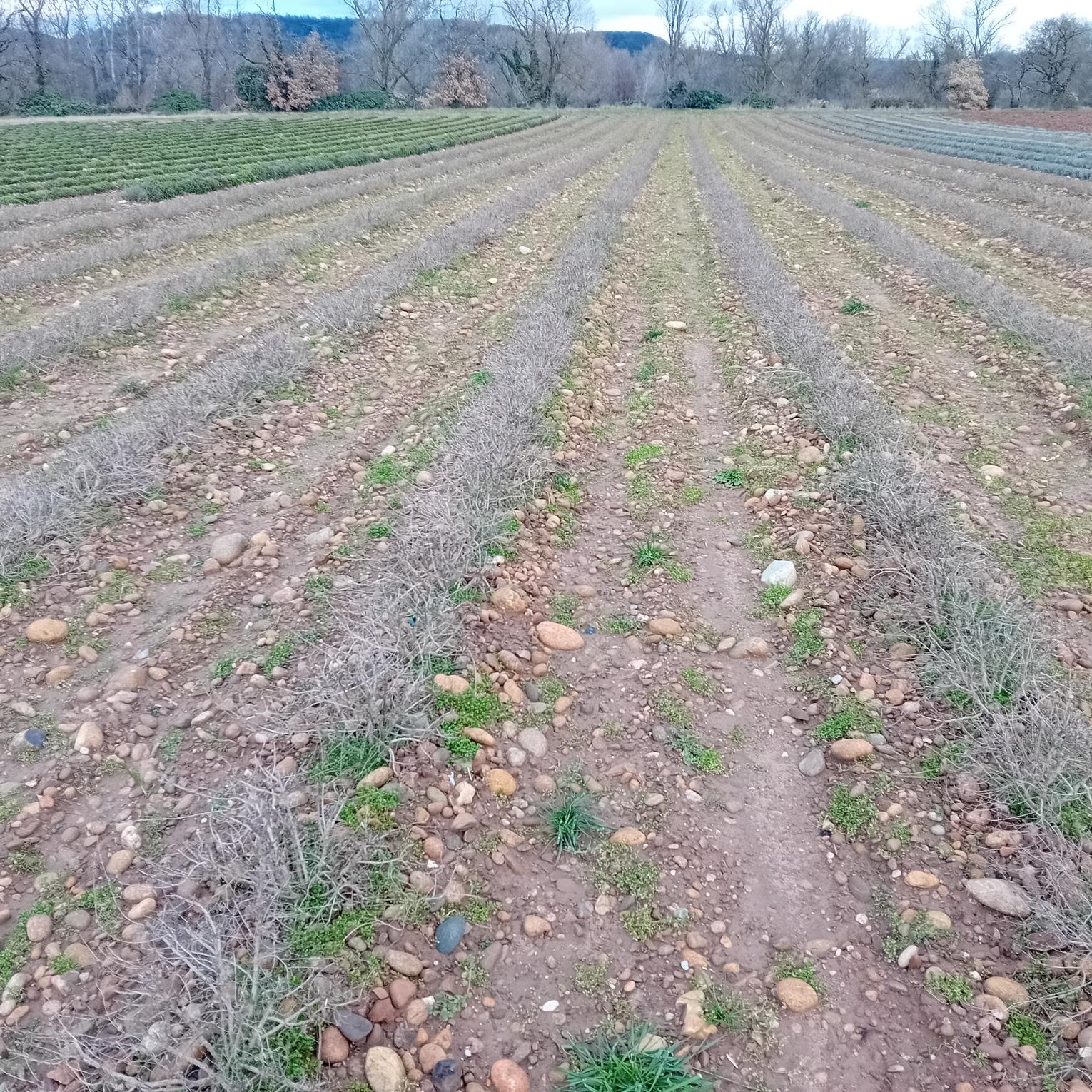
  • For shrubs (lavender, verbena), frost first affects the aerial parts. If the cold is intense and prolonged, the root system may also be damaged.
  • A young plantation with poorly established roots is highly vulnerable. Even greenhouse-grown plants must be properly hardened off.


Contrary to some common beliefs, a plant weakened by summer drought will be more sensitive to frost. It has fewer reserves to withstand cold stress.


Typical symptoms:
“Cooked” or burned appearance, wood necrosis, poor spring regrowth, partial loss of plants.


Le gel et les PPAM

In the current context, water management influences winter tolerance. The damage threshold depends on the species, the duration of the cold, the physiological condition of the plant, the protection measures in place. A short, dry frost will not have the same impact as a prolonged cold spell with wind. However, no significant changes have been observed : the chemical composition remains stable, the organoleptic profile remains unchanged, there is no impact on hydrolats or floral waters derived from essential oils. 

In the majority of cases:

  • Mediterranean medicinal and aromatic plants are adapted to winter cold

  • Risks mainly concern sensitive or recently introduced species

  • The main leverage remains varietal choice and crop scheduling

Frost is an agronomic factor to consider, but it is rarely a fatal issue if the cropping strategy is properly adapted.

Discover our products
Newsletter

New products, trade shows, market reports… Sign up to receive our latest news straight to your inbox!