

- 24 July 2026
- Return
We often imagine that a plant produces only one essential oil. Yet the Bitter Orange tree, Citrus aurantium, shows us that a single tree can give rise to several aromatic extracts, with very different compositions, aromas, and properties.
The Bitter Orange Tree: three parts, three extracts
Depending on which part of the plant is used, three distinct aromatic products can be obtained:
Why such a difference ?
The answer lies in the very biology of the plant.
A flower, a leaf and a fruit do not have the same role. Each of these organs must perform a specific function and therefore has its own distinct metabolism.
The Bitter Orange Tree is not an isolated case...
This phenomenon is by no means unique to citrus plants.
Cinnamon, for example, can provide an essential oil obtained from the bark and another from the leaves, with different chemical compositions and aromatic profiles.
The same principle can be observed in clove, coriander, dill, and many other aromatic plants.
The part of the plant chosen for extraction is therefore never a minor detail: it directly influences the composition of the resulting extract.
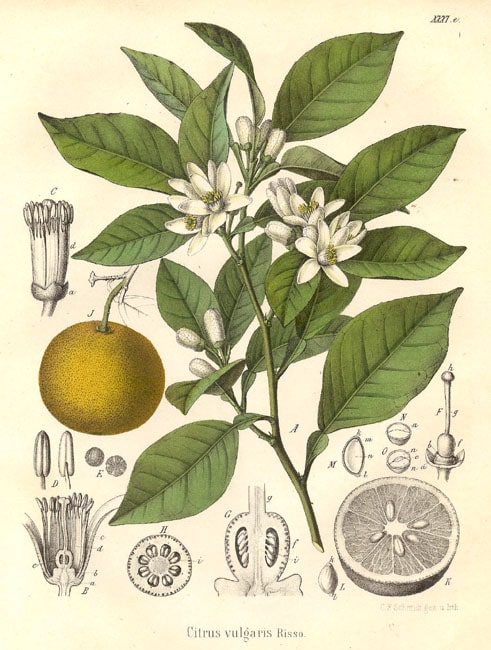
The Plant at the heart of understanding Aromatherapy
Observing the plant itself helps us better understand the origin of essential oils and essences.
Plant chemistry is not randomly distributed. It is closely linked to the needs of each organ and the functions it must perform. Aromatherapy directly benefits from this extraordinary organization of the living world.
Understanding which part of the plant is used, how it is extracted, and why it produces certain molecules therefore helps us better understand the characteristics of the resulting aromatic extract.
Nature does not produce its molecules at random. It shapes them in response to specific needs. Understanding the plant is already a major step towards understanding aromatherapy.
And the Bitter Orange tree is a wonderful illustration of this: one tree, three different parts… and three unique aromatic expressions.